
12th July is the last day to register on a Pakistani passport for 2026 Hajj
Many pilgrims walk past it without realizing its immense significance. Nestled beside the Ka‘bah is a curved, white-marble area known as Hateem, also called Hijr Ismail, a sacred space that holds a unique status in Islam. Praying here is not just highly recommended; it carries the reward of praying inside the Ka‘bah itself.
The Prophet ﷺ said:
“Perform Salat in the Hijr if you want to enter the House, for indeed it is part of the House.”
(Jami‘ at-Tirmidhi 876)
Understanding what the Hateem is and how to access it can greatly enhance your Umrah or Hajj experience.
The Hateem, also known as Hijr Ismail, is the semi-circular area attached to one side of the Ka‘bah, enclosed by a low marble wall. Although it appears outside the Ka‘bah today, it is officially considered part of the Ka‘bah.
When Prophet Ibrahim عليه السلام and his son Ismail عليه السلام originally built the Ka‘bah, this area was included within its structure. However, years later, before the Prophet Muhammad ﷺ received revelation, the Quraysh rebuilt the Ka‘bah. Due to a shortage of halal funds, they excluded this portion from the structure, leaving it outside the walls.
Despite this physical separation, its spiritual status never changed.
Aisha رضي الله عنها narrated:
“I wanted to enter the House to perform prayer, so the Messenger of Allah ﷺ took me by the hand and placed me in the Hijr and said:
‘Pray here if you wish to enter the House, for it is part of the Ka‘bah.’”
(Jami‘ at-Tirmidhi 876)
This is why scholars agree that prayer in the Hateem carries the reward of prayer inside the Ka‘bah.
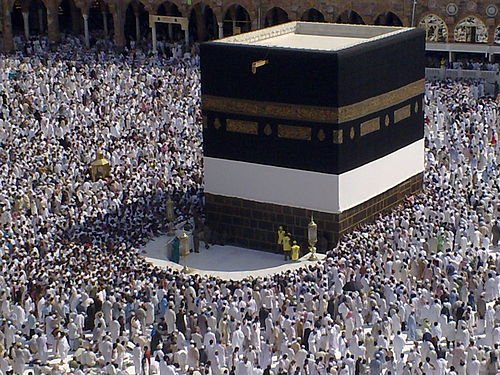
Praying inside the Ka‘bah is a rare opportunity, available only to a select few. However, Allah, in His mercy, has made the reward accessible to every pilgrim through the Hateem.
When you pray in the Hateem, you are:
This makes the Hateem a powerful place for dua, repentance, and heartfelt supplication.
Due to limited space and high demand, access to the Hateem is carefully regulated.
Entry Point: Bab al-Fath (Gate 45)
Time Inside: Approximately 3–4 minutes
(Maximum allowed is 10 minutes, though this is rarely reached)
Security staff manage entry strictly, especially during peak Umrah and Hajj seasons.
If you’re hoping to pray in the Hateem, preparation is key.
Because the time inside is short, it’s best to make intention and dua beforehand, so you can focus fully when you enter.
Even a brief moment inside the Hateem can be spiritually transformative when approached with awareness.
The Hateem is a powerful reminder that Allah’s mercy is vast and accessible. While not everyone may enter the Ka‘bah itself, Allah has placed its reward within reach of every pilgrim.
As you plan your Umrah or Hajj, don’t overlook this sacred space. Learn its history, respect its etiquette, and seize the opportunity, because a few moments in the Hateem can leave a lasting imprint on your heart.